Dangerous Road Design Putting Walkers, Bikers at Risk in Upstate NY

A new report from AARP New York, authored by Tri-State’s Michelle Ernst, highlights the dangers to pedestrians and bicyclists in five upstate counties.  The report, Making New York a Complete Streets State, examines state and federal data to identify the most dangerous intersections to walk or bicycle in upstate’s most populous counties.  Its release [...]

It Takes a (Small) City: Tackling Childhood Obesity with Complete Streets

Like policymakers across the country, officials in the small Hudson Valley city of Kingston, New York have found that tackling childhood obesity requires a big toolbox that includes both education and investment in safe routes for walking and biking. To this end, the city’s “A Healthy Kingston for Kids” initiative, funded by a $360,000 [...]

Long Island Senators Join Push For Safer Streets

State Sen. Craig Johnson, center, with AARP members and advocates in New Hyde Park yesterday.

NY State Senator Craig Johnson stood up for safer streets on Monday, agreeing to co-sponsor state complete streets legislation (SB5711/A8587) after participating in a “walkability audit” in New Hyde Park with AARP volunteers, New Hyde Park Village Trustee [...]

NJ Complete Streets: Victory or Empty Rhetoric?

Heeding the call from Tri-State and other groups, the New Jersey Department of Transportation has adopted a complete streets policy, signed by Commissioner Stephen Dilts on December 10th.  Complete streets is a policy that requires new or rehabilitated roads to be built for all users, including walkers, cyclist, transit riders, and drivers.

Following Connecticut’s passage of Senate Bill 735 this summer, NJ is the second state in our region to make complete streets official policy.  New York currently has a complete streets bill pending in the State Legislature.

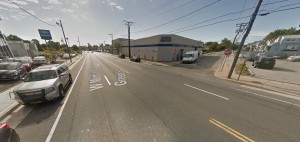
Routes 1 & 9 in Avenel.

The policy attempts to make roads like Route 1&9 in Avenel safer. In January, a man was killed attempting to cross the road.

NJ’s departmental policy establishes “a checklist of pedestrian, bicycle and transit accommodations” like sidewalks, crosswalks, bike lanes, and medians, “with the presumption that they shall be included in each project” constructed by the department. It represents progress for an agency that has been backsliding under the Corzine Administration and losing its title as one of the most innovative transportation departments in the country.

Unfortunately, the policy contains overly broad exceptions and lacks any public process, both of which could undermine its effectiveness.

The policy contains five enumerated exceptions, reprinted below.  They include exceptions for safety, cost, and lack of need that are present in most existing complete streets policies.  However, NJ adds an exception where the “timing of a project is compromised by the inclusion of complete streets.”  It is not difficult to foresee abuse of this exception.  Adding complete street features to a construction project that did not previously include them can potentially lengthen the project’s timeline.  The policy document offers no guidance as to what length of time may count as significant.

The real danger resides in an exemption that allows project engineers to ignore the requirements of the policy for any reason, so long as it is internally documented and approved by the Capital Program Committee and Commissioner. Public input is left unmentioned in this, or any other section, of the policy.  Contrast this to a similar exception proposed in Delaware where waivers are very limited and subject to two appeal levels and approval by up to nine officials.

Still, the policy is a good step and gives Governor-elect Christie’s administration an opportunity to strengthen the policy and ensure New Jersey Department of Transportation regains its foothold as a innovative and sustainable transportation leader.

Comparing Exemptions in Tri-State Policies:

For comparison, here are the exemption sections from Connecticut’s law, New York’s proposed legislation, and New Jersey’s complete streets policy.  While each contains overly broad categories for exempting projects, NJ includes and expands the exemptions to the point that the policy directive can be rendered meaningless:

» Continue reading…

Groups: New Jersey Needs a Complete Streets Policy

Cherry Hill.

Have you ever seen a road that ends abruptly in a patch of grass? It's doubtful, since engineers design roads to precise specifications. But the same can't be said of sidewalks and bike lanes in much of NJ.

This article was co-written with NJ Future’s Jay Corbalis and is cross-posted at Garden State Smart Growth:

2009 has been a grim year for New Jersey’s pedestrians: Through the end of September, 121 pedestrians have been killed in traffic collisions, according to a Tri-State analysis of state data. This is a 33% increase over the same period in 2008, during which 91 pedestrians lost their lives.

In response to this mounting toll, Tri-State and NJ Future joined the NJ chapter of AARP, Environment NJ, Disability Rights New Jersey, and the Bicycle Coalition of Greater Philadelphia today to call on Governor Corzine to take his pedestrian safety efforts a step further and enact a Complete Streets policy in New Jersey. The governor announced a five-year, $74 million pedestrian safety initiative in 2006 that has had visible results in the state.

A Complete Streets policy would require that engineers design roads to accommodate the needs of all users, except where infeasible, any time a new road is built or an existing road is retrofitted. Tri-State helped win passage of complete streets legislation in Connecticut this year; other states with complete streets policies include Delaware, Oregon, and Illinois (a complete list can be found here).

There’s no guarantee that better street infrastructure would have prevented the deaths of any of the 121 people who lost their lives while walking in New Jersey this year. But as the photos below show, when transportation planners prioritize automobile movement and treat other considerations as afterthoughts, the result is incomplete streets that create dangerous conditions:

Click to view incomplete streets from around the state:

Gov. Rell Signs Complete Streets Bill Into Law

Over the holiday weekend, Governor Rell took time out from budget negotiations with legislative Democrats to sign the Complete Streets bill, legislation that was passed last month by the Connecticut General Assembly.  The law, the first of its kind in the tri-state area, dedicates 1% of transportation funding to bike and pedestrian infrastructure, establishes [...]

ConnDOT Can Fill Gaps in Complete Streets Legislation

Last month, overwhelming majorities in the Connecticut State Senate and House passed a complete streets bill, a major step towards safer streets for all road users in the state.  This week, Tri-State urged ConnDOT Commissioner Joe Marie to make up for one of the few gaps in the new legislation.

The new legislation dedicates [...]

Complete Streets Headlines Slate of NYS Transportation Bills

New York’s legislative session shows little sign of cooling down, with four potentially impactful bills introduced into the State Assembly and Senate Transportation Committees last month. The bills would mandate complete streets, create a regional bus authority, introduce new penalties for careless driving, and require the MTA and Thruway Authority to implement high-speed tolling [...]

Action Alert: Tell CT Legislators You Support Complete Streets!

[Update: The bill passed the Planning and Development Committee.]

A Connecticut complete streets bill continues to make its way through the legislative process. Yesterday, the State Senate referred Senate Bill 735 to the Joint Committee on Planning and Development, which will hold a hearing on the bill on Monday, April 13th, at 1 pm [...]

Complete Streets Bill on the Right Path

The Connecticut Transportation Committee is set to hear testimony on a “Complete Streets” bill (SB 735) on Wednesday, March 11 at 10 am at the Legislative Office Building in Hartford.

The legislation requires that any funds received by ConnDOT or municipality for “the construction, resurfacing, restoration, rehabilitation or relocation of highways, roads or streets, [...]