
 New Jersey's Transportation Trust Fund is coming up against its bond cap | Chart: New Jersey Office of Legislative Services
Years of borrowing and a failure to raise the gas tax for over 20 years has led New Jersey’s Transportation Trust Fund (TTF)—established in 1984 to fund transportation capital projects—to be engulfed in debt payments. Yet even with this transportation crisis looming, the state of New Jersey has not acted to shore up its long-term transportation finances. Instead, last year, Governor Christie announced a five-year transportation funding plan for the fiscal years 2012-2016 that has been widely criticized as unsustainable.
Now, a new Office of Legislative Services (OLS) report has given the patchwork funding plan’s critics even more credibility: the paper, composed by a nonpartisan government entity, outlines four unresolved issues for the future of New Jersey’s transportation funding:
- The Transportation Trust Fund needs its bond cap raised: TTF legislative authorization to raise the bond cap is necessary before fiscal years 2013-2016 of the five-year plan can be completed. According to the TTFA funding plan for the fiscal year 2013, $986 million in TTF Authority bonding credit is needed to meet the year’s budget needs, but only $326.3 million in bond authority remains from the last reauthorization of the TTF in 2006.
- There is a lack of dedicated revenues: The current five-year program relies heavily on general fund transfers without identifying new dedicated revenue sources. As a result, transportation funds are not protected against “redirection or reduction” and are subject to budgetary action each year. This means that funding from the general fund can only be assumed through the 2016 fiscal year.
- New Jersey’s plan for its transportation network keeps capital program expenditures at their current levels: Since 1984, the TTF has never gone more than five years without increasing the size of the capital program. The current capital program keeps appropriation at a constant level of $1.6 billion/year for 10 years (2007-2016), instead of increasing it to meet the rising costs of projects. Failing to increase the size of the capital program actually means that the state will be contributing less in real dollars to its transportation system because $1.6 billion in 2016 dollars is significantly less than $1.6 billion in 2007 dollars.
- Funding is not assured after 2016: The five-year capital program’s funding comes from a variety of sources, including toll hikes from the New Jersey Turnpike Authority meant for the cancelled Access to the Region’s Core project and one-shots from the Port Authority of New York and New Jersey for certain projects. Neither of these two sources are permanent commitments that will last beyond 2016, which will leave a funding gap of at least $692 million. For the 2017 fiscal year and beyond, New Jersey will have to find a way to come up with new money simply to maintain current funding levels. Unless new dedicated funding is introduced, there will be an even heavier reliance on unstable, unpredictable general fund transfers.
 Capital Bikeshare in Washington, D.C. has a 97% farebox recovery ratio; if New Haven gets funding for its own, it expects roughly the same | Photo: flickr/zcopley
At Tri-State’s April 11 Sustainable Streets forum, New Haven Director of Transportation, Traffic, and Parking Jim Travers told attendees that his city was looking into a public bike share system. Two weeks later, the New Haven Independent reports that the city has applied for a $400,000 grant to set up a 10-station bike share.
The grant—provided by Connecticut’s South Central Regional Council of Governments—would, in the words of Jim Travers, “get us up and running,” but he would hope to work with New Haven’s hospitals and universities to add even more bike share locations.
The grant proposal is good news for sustainable transportation advocates, and there’s even more good news for budget hawks: bike shares are proving extremely cost effective. In Washington D.C., for example, the bike share boasts 97% farebox recovery, and New Haven expects the same.
“The system ultimately would pay for itself,” said Travers.
In a region where municipalities of all sizes are implementing bike share programs, the city’s move comes as no surprise (especially considering its track record of support for progressive transportation policy). From Collingswood, New Jersey to New York City, bike shares are popping up, and by the end of the summer, we’ll know if we can add New Haven to that list.
The city has also applied for three other grants, all geared towards improving the transportation network. New Haven is seeking funds for downtown traffic signal replacement, a study on traffic signal timing, and a study on making some one-way streets bidirectional.
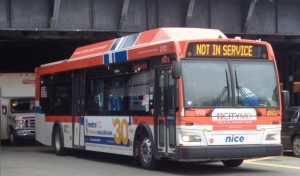
 Remapped bus bays in Hempstead, the result of NICE Bus' service changes. CMAQ funds could be used to mitigate these cuts.
Yesterday, Tri-State submitted comments opposing the deletion of a crucial item from the New York Metropolitan Transportation Council’s Transportation Improvement Program (TIP): $2.625 million in Congestion Mitigation and Air Quality (CMAQ) funding that would be granted to Nassau and Suffolk Counties over the next 3 years. The item is listed as an “innovative transit project for new bus service by private operators.”
According to CMAQ guidelines, Nassau County could use these funds to support “the incremental cost of expanding existing transit services,” which means that Nassau could use the funds to mitigate the April 8 cuts that impacted 60% of routes in the county. While the CMAQ funding would not be sufficient to fully restore service on all routes, the money could be used to reinstate some service on higher ridership routes or those in areas that now have little service remaining.
Similarly, Suffolk County could use the CMAQ funds to help pay for “new transit services,” which is also an appropriate use of CMAQ funding. Coupled with the revenues to be generated by a May 1 Suffolk County Transit fare hike and increased operating assistance from New York State, the CMAQ funds could allow the county to add Sunday service to its routes.
In an era of limited resources, local governments can’t afford to turn down money that would allow them to meet the growing demand for transit service.
 Riders board the NICE Bus at the Rosa Parks Hempstead Transit Center
Tomorrow, April 25, Nassau County’s Bus Transit Committee will host a public meeting beginning at 4p.m. At the event, officers will be elected, the committee will “attend to other organizational issues,” and Veolia, which assumed control over the county’s bus system on January 1, will deliver a report.
The meeting is not listed on NICE Bus’ website, and its subject and format are unclear to riders and advocates.
The event will be held at the Theodore Roosevelt Executive and Legislative Building, 1550 Franklin Avenue, Mineola, NY.
 Assembly Speaker Sheldon Silver backs legislation to regulate the intercity bus industry | Photo: assembly.ny.state.us
In 2009, Tri-State released a report on improving New York City’s booming intercity bus business, which, over the past decade, has significantly altered the way that people travel between the metropolises of the Northeast and the Mid-Atlantic. Now, New York State lawmakers and New York City politicians have announced legislation that would implement one of Tri-State’s recommendations: establishing a set of rules for intercity buses. Separate bills on the topic have passed the New York State Assembly and Senate, and the legislation unveiled today bridges the gap between them.
The bill, which has the support of Assembly Speaker Sheldon Silver, State Senator Daniel Squadron, New York City Councilwoman Margaret Chin, and New York City Department of Transportation Commissioner Janette Sadik-Khan, would authorize New York City to establish a permit system for intercity buses. The bill would grant municipal control over where the vehicles can load and unload and require bus operators to provide information about planned bus timetables, proposed stops, and off-duty parking locations when applying for a permit. In approving bus stop locations, the city would have to consult with community boards (and, if necessary, the MTA). The city would also be free to charge up to $275/vehicle annually for permits and could fine bus operators up to $1,000 for their first violation and up to $2,500 for further violations.
The legislation, if passed, would address concerns raised by bus riders and Manhattan neighborhoods such as rotating, overcrowded bus stops and hard to find bus arrival information.
Your weekly guide to heroic and villainous actions in tri-state transportation and development.
Winners
 Senator Golden has reintroduced legislation that protects the funds that keep New York State's transit running | Photo: NYSenate.gov
Assemblyman James Brennan (D-Brooklyn) and Senator Martin Golden (R-Brooklyn)—After a bill to safeguard New York’s transit funding was defanged late last year, the lockbox bill is back and better than ever. Assemblyman Brennan and Senator Golden have introduced a broader version of the legislation, which now protects against the diversion of funds dedicated to New York State’s 130 transit systems.
Manhattan Borough President Scott Stringer—While it remains to be seen if the commuter tax proposed by Borough President (and mayoral candidate) Scott Stringer is the best solution to the MTA’s funding woes, he should be praised for putting transit at the center of next year’s mayoral race in New York City.
The New Jersey Department of Transportation—Not content with its own internal complete streets policy, NJDOT is now helping municipal officials make their roadways friendlier to pedestrians and cyclists. A series of workshops is bringing expert advice to local governments, which could make New Jersey’s streets safer and more vibrant.
The City of New Britain—Seizing on the potential of the Hartford-New Britain Busway to make the city a transit-oriented destination, New Britain is already at work creating pedestrian-friendly infrastructure in its downtown.
Losers
Bronx Parking Development Company—After $100 million in city and state aid, along with $237 million in tax-free bond financing, the company that built parking garages by Yankee Stadium has told the Securities and Exchange Commission that it will likely default.
Connecticut State Senator Joseph Markley (R-Southington) and Representative Whit Betts (R-Bristol)—Even as central Connecticut moves to capitalize on the busway’s economic potential, its opponents are trying to thwart the project through fear mongering and procedural maneuvering. Senator Markley and Representative Betts have attached busway-killing language to several bills that would protect Connecticut’s first responders, and their move threatens the livelihoods of those that need better transit and those that are counting on jobs from new economic development.
House Speaker John Boehner (R-OH)—The House, which could not pass its own transportation bill earlier this year despite the bipartisan model offered by the Senate, instead ushered through a “dirty” extension of current transportation policy this week. While extending the status quo for 90 days, the legislation also included the approval of the Keystone XL pipeline, the deregulation of coal ash, and provisions that would gut the environmental review process. This piece of legislative gamesmanship intends to give the Republican-controlled House leverage in negotiations with the Senate and puts partisan politics ahead of forward-thinking national transportation policy.
 Assemblywoman Glick has introduced legislation that would bring speed cams to New York City
Legislators returned to Albany this week after a two-week hiatus, and with less than 30 session days left between now and the end of the legislative year, advocates and politicians got to work immediately.
Speed Camera Lobby Day
On Tuesday, Transportation Alternatives held a lobby day in support of speed camera legislation sponsored by Assemblywoman Deborah Glick (D-Manhattan). The bill (A7737)—supported by the Bloomberg Administration—would place 40 cameras in the city to help enforce the speed limit. Studies have shown that speed cameras successfully reduce injuries and fatalities by 40%, while reducing speeding by 71% at camera-monitored sites. In 2010, pedestrians accounted for 55% of traffic fatalities in New York State, and speeding claimed twice as many lives as distracted driving. Reducing speeds will help change that. That’s because if a pedestrian is hit by a car traveling at 40 mph, there is a 70% chance that they’ll be killed; at 30 mph, there’s an 80% chance they’ll survive.
The Return of the Lockbox
Last year, transit funding “lockbox” legislation—which would have ensured that the diversion of dedicated MTA funds for other purposes was thoroughly documented—passed both chambers but was gutted as part of a deal that restructured New York’s income tax and scaled back dedicated funding for the MTA. Now, Assemblyman James Brennan (D-Brooklyn) and Senator Martin Golden (R-Brooklyn) have reintroduced the lockbox bill (A9017/S6170), and it’s better than ever. Instead of just protecting MTA funds, it safeguards dedicated funding for the 130 transit systems across the state. The bill would require an “impact statement” when transit funding is diverted, which would include information about how funding cuts impact riders. Such a statement, outlining the dire consequences of transit funding cuts, could discourage legislators from defunding the transit systems that power New York State’s economy. This would help make fare hikes less likely and shed light on reallocations of supposedly dedicated transit revenues, such as the one that reduced the MTA’s funding in 2009.
Next Steps
Neither bill is a sure thing. The speed camera bill, which has failed in past years, needs a Senate sponsor. Meanwhile, there is widespread support for the transit lockbox among legislators, with upstate representatives showing a particular interest in signing on. Securing Governor Cuomo’s signature will be the real hurdle.
 An NBC reporter walks through an empty parking garage by Yankee Stadium | Image: NBC New York
Several years ago, when the Yankees proposed to build a new stadium in the Bronx, advocates campaigned against the parking garages that were planned to go with it. The facilities, they reasoned, were unnecessary, since fans had long been able to get to Yankees games without the 75% increase in parking capacity that the lots would bring. A coalition of advocates argued that it would be better to invest in transit and save the parkland on which the garages were to be constructed, but the facilities were built nonetheless (partially with taxpayer money). In a victory for sustainable transportation advocates, though, the city pitched in to help the MTA build a new Metro-North station within walking distance of the stadium.
Now, three years after the stadium’s construction, the owners of the parking facilities have told the Securities and Exchange Commission that they will likely default on the tax-free bonds that financed the project. Why? Nobody’s parking there. NBC recently visited a garage near Yankee Stadium midway through the team’s home opener and found that three of its four floors were empty, and last year, the company’s lots were 43% full on the average gameday.
And that Metro-North station? It’s booming. By all accounts, people love the service, and on the same day that NBC found the empty parking lot, the MTA announced that its Yankee Stadium stop had broken the record for the highest weekday ridership at the station during a regular season game. Over 5,100 people arrived at the game by commuter rail—that amounts to about 1 in 10 fans. Metro-North isn’t the only way for people to get to Yankees games by transit, either: over 8.6 million people swiped their MetroCards at the 161st St-Yankee Stadium subway station in 2011. This 2.3% increase in subway ridership over 2009’s figures (the year when the Metro-North station opened) is particularly impressive because the commuter rail presumably drew away some of its straphangers.
As similar projects in New York City move forward, the city and state should heed the lessons of Yankee Stadium. Instead of subsidizing parking with $100 million aid packages and hundreds of millions in tax-free bond financing, they should prioritize funding for transit projects, like the $39 million contribution that helped the MTA build its new Metro-North station. There is only so much money; it should be spent wisely.
Since returning to work on Monday, House leaders have claimed they want to get moving on a long-term transportation bill, and they’ve begun the process by tying a 90-day extension of current policy to the controversial Keystone XL pipeline. Passage of the extension could start the conference committee process, with negotiators from the House and Senate working out differences between the House package and the Senate’s already-passed MAP-21 transportation bill, legislation that contains a number of positive reforms and would fund transportation through the end of the 2013 fiscal year.
But the House’s still-forming bill (HR 4348) could gut the review process that ensures transportation projects don’t plow through local communities or damage environmentally sensitive areas. And it could be loaded down with other unrelated “poison pill” provisions that would slow negotiations down.
An Unclean Extension
 Wisconsin Congressman Reid Ribble's amendment would gut the review process that keeps America's communities safe | Photo: ribble.house.gov
As the Keystone XL provision suggests, the House extension of the transportation bill would not be a straightforward (“clean”) continuation of policy. Some House members argued that, in addition to Keystone, parts of HR7—the House’s failed transportation bill—should be added to the legislation.
As a result, a handful of amendments to the extension will be debated before the House votes on the bill. One of these amendments (offered by Rep. Reid Ribble of Wisconsin) would add many of the “environmental streamlining” provisions from HR7—provisions that would go far beyond any reasonable efforts to speed up project delivery and endanger the environment and local communities. For example, if an environmental review for a project takes longer than nine months, the project would automatically be approved, regardless of its impacts.
Another amendment, from West Virginia Rep. David McKinley, would get the federal government out of regulating “coal ash.” Like the Keystone pipeline authorization, this is an environmental provision that is both controversial and unrelated to transportation. Yesterday afternoon, the White House threatened to veto the House’s bill—a clear sign that attaching Keystone and other partisan provisions to a transportation bill could sink the whole effort.
The House’s bill is scheduled to be voted on at 3:45 pm today (with necessary procedural votes scheduled for earlier in the day).
The Right Way Forward
The country hasn’t passed a long-term transportation bill since the last one expired 931 days ago. Passing the Senate’s transportation bill, or a “clean” extension bill that allows negotiations to begin with the Senate, are the surest ways for the House to make progress toward bipartisan transportation legislation that will put Americans back to work and make sure they can get there. Today’s political maneuvers are a dead-end street.
Tell Congress to stop playing games with the federal transportation bill on TSTC’s website.
 Connecticut Governor Dannel Malloy signed the Full Funding Grant Agreement for the Hartford-New Britain Busway in November, and five months later, people are already investing in the areas around its future stations | Photo: Scott Vargas/FoxCT
Even before a shovel has been put into the ground, the Hartford-New Britain Busway project is already leading developers to invest millions of private dollars in the areas around future busway stations.
According to Gerry Amodio, executive director of the New Britain Downtown District, there are plans for a $35 million mixed-use development near the proposed Cedar Street bus station in Newington. Mr. Amodio also spoke of developers in New Britain who are purchasing and upgrading property near future busway stations. “A mixed-use property near the downtown New Britain station was recently bought for $325,000, and an additional $125,000 has been invested for improvements,” said Mr. Amodio.
Elsewhere in New Britain, according to Mr. Amodio, restaurants and nightlife spots are using their dollars to revitalize the business environment—a restaurant on Main Street invested in $300,000 of upgrades to cater to students from the nearby Central Connecticut State University, who are expected to visit the area via the busway. And the new owners of another restaurant attached to the LaQuinta Hotel, directly across the street from the New Britain Downtown Terminal, invested $1.2 million in redevelopment funds to prepare for the busway’s arrival.
The City of New Britain is also doing its part to make the areas around busway stations walkable, bikeable, and livable. The city has secured almost $2 million in streetscaping grant funding, $110,000 from the National Parks Service to construct wayfinding signs, and $750,000 in state grants to support transit-oriented development. The city is also set to receive a $3.2 million Federal Transit Administration Bus Livability Grant in July. The increased foot traffic on the new, pedestrian-friendly streets should bring even more business to the city’s downtown.
The influx of investment near busway facilities comes as no surprise in light of the numerous studies that have shown a correlation between rising property values, economic development, and proximity to bus rapid transit stations. A recent letter to the editor written by Tri-State, Transit for Connecticut, and the Capitol Region Council of Governments said as much, and highlighted the even greater potential for future development along the corridor.
|
Masthead Mobilizing the Region is published by the staff of the Tri-State Transportation Campaign.
Editors
|