
NJ Future's Redevelopment Forum is Soon [Updated]

[Update: This event will now take place on March 19.]

This Friday is New Jersey Future’s Redevelopment Forum, one of the state’s largest events for municipalities, developers, and advocates interested in smart growth.  The event’s keynote speaker is Shelly Poticha, the Senior Advisor for Sustainable Housing and Communities at the US Department of Housing and Urban Development, who will discuss the department’s new “livable communities” initiatives. Lieutenant Governor Kim Guadagno will also offer remarks during lunch.

Event workshops range from ground-level sessions, on topics like green building design and how municipalities can attract employers, to policy-focused discussions on New Jersey’s new complete streets policy and new transit projects in northern and southern Jersey. Tri-State executive director Kate Slevin will join a panel discussing the looming bankruptcy of the state’s Transportation Trust Fund (which funds state road, bridge, and transit projects) and what it will mean for localities.

Learn more and register for the event at NJ Future’s website.

Bookmark and Share

Students -- Not State -- Showing Leadership on MTA School Fares

The cost of providing free NYC student MetroCards is shared by the MTA, city, and state. But the MTA's share of the cost has grown over the years, and the state dropped its share to nearly nothing in 2009.

At tomorrow’s MTA board meeting, New York City students will ask to meet with MTA Chairman Jay Walder and discuss the agency’s plan to begin charging students who currently use free MetroCards to get to and from school. Pointing out that hundreds of thousands of students and parents will be impacted, members of the Urban Youth Collaborative Student Union are asking that the MTA stop cuts to the program.

These students deserve a meeting, and the Working Families Party is asking supporters to sign on to their requests. But this energy also needs to be directed at Albany lawmakers, who are lashing out at the MTA for the student fare hike — even though it was they and Gov. Paterson who helped create the MTA’s current crisis. Last year, Albany politicians slashed state funds to the agency– including funds for the MetroCard program, which is jointly paid for by New York City, the state, and the MTA. As the Daily News pointed out in an editorial last week:

… New York has a new gold standard for chutzpah – in the form of 24 members of the Assembly who are excoriating the Metropolitan Transportation Authority for the lawmakers’ own crimes against straphangers.

Two months ago, these two dozen – led by Richard Brodsky of Westchester – voted to wipe out state funding for student MetroCards. That decision is the reason parents are facing the prospect of having to pay for their kids’ transportation to and from school.

It is also the reason parents are furious. So, now Brodsky & Co. have had the gall to attack the MTA as “disgusting,” “shameful” and “immoral” for following through on a decision made by them.

The Assemblymembers — most of whom are from New York City — claim that transporting students costs the MTA “close to zero” because students are simply riding buses and trains that NYC Transit would run anyway. But that’s not true. As Straphangers Campaign senior attorney Gene Russianoff tells Streetsblog, 20% of bus service during the morning peak is needed to handle the student load. After school lets out, student traffic also creates an early afternoon rush period that would not otherwise exist.

[Update 2/24: In the comments, a member of the Urban Youth Collaborative shares the message that was delivered at this morning's meeting, which is a little broader than was first indicated. It reads in part:

...The students need our own hearing because this issue affects us the most, and our voices will not be heard at the scheduled public hearings. We understand that the MetroCards are not just the responsibility of the MTA, but also the Mayor and the Governor. Since we haven’t heard back from you, I’m here personally to invite Chairman Walder to meet with students to figure out how we can save the MetroCards and put pressure on the Mayor and the Governor to do their part. ]

Image: MTA presentation via Second Avenue Sagas.

Bookmark and Share

Jobs Bill Has Uncertain Ramifications For Transit

A federal jobs bill could help support needed investment in transit projects and service across the country.

With the one-year anniversary of the federal stimulus last week, policymakers and advocates have cited infrastructure-related job creation numbers in support of a transportation-heavy “jobs bill.”  Only 6% of the original stimulus ($46 billion out of $787 billion) went to transportation, while the $154B jobs bill passed by the House last December includes over $37 billion for transportation (including $27.5 billion for roads, $8.4 billion for transit, and $800 million for Amtrak), a higher share.

Seventeen Senators including Frank Lautenberg (D-NJ), Bob Menendez (D-NJ), and Kirsten Gillibrand (D-NY) are calling for legislation with significant investment in transportation infrastructure as the best way to create and sustain jobs.

An infrastructure-focused jobs bill could also allow transit agencies to scale back service cuts and fare hikes like those planned in New York and New Jersey. The House version of the bill allows up to 10% of the federal transit funds in the bill to be used towards operating expenses. Research has shown that transit investment, especially in operations, creates more jobs than other types of infrastructure spending (see, for example, studies available here, here, here and here).

But the Senate and House approaches seem very far apart.  Today, Senate Majority Leader Harry Reid is trying to pass a pared-down $15B jobs bill package which largely maintains the transportation status quo. It would plug a hole in the gas-tax-supported highway trust fund, expand the Build America Bonds financing program for large infrastructure projects and extend the existing transportation law, SAFETEA-LU, until the end of the year.

Senate leaders have suggested that they will seek to pass a second, infrastructure-focused jobs bill. But it remains uncertain how much help — if any — transit riders can expect from Congress.

Images: Left – Photo of Second Avenue Subway construction courtesy The Launch Box (via Second Ave. Sagas); Right – closed St. Louis bus stop via Urban Milwaukee.

Bookmark and Share

Major Fare Increases Coming to NJ Transit, Agency Head Suggests

Commuters packed Wednesday's NJ Transit board meeting to testify against fare hikes.

The grim ramifications of Gov. Christie’s plan to slash NJ Transit funds are becoming clearer.  New NJ Transit executive director James Weinstein acknowledged that a 20-30% fare increase and a “4% service cut” could be on the way, speaking at an NJ Transit board meeting on Wednesday and at a hearing of the State Assembly Transportation Committee yesterday.

Testifying at both hearings, Tri-State Transportation Campaign New Jersey Advocate Zoe Baldwin pointed out that a 30% fare increase will mean that transit fares will have increased by about 75% since 2000. The state gas tax has not been increased since 1988. She called on the governor to restore transit funds so that “riders are not literally left out in the cold.”

At the Assembly hearing, Transportation Chair John Wisniewski was skeptical of the governor’s claim that NJ Transit was a haven for “patronage hiring” and asked Weinstein to clarify. Weinstein said he couldn’t “identify where the patronage jobs are at this point” but that the governor had ordered a review of the agency.

Beyond the current year’s budget cuts, Weinstein warned that NJ Transit was facing a $300 million deficit in fiscal year 2011. He said that NJ Transit would schedule public hearings on the fare hikes and service cuts next month in Camden, Atlantic City, Trenton, Newark, Secaucus, Paterson, Hackensack, Manalapan, and New York City.

Image: Via WABC-TV.

Bookmark and Share

Rail Mirage May Endanger CT Busway Project

The Hartford-New Britain busway (shown in red) will do more than link two cities. Buses from many destinations will use the busway for parts of their routes (shown in green), providing benefits to places like Bishop's Corner and Waterbury (detail shown here; click for full image).

Are Connecticut officials going to miss out on almost $300 million in federal transit funds because of a dispute over the New Britain-Hartford Busway?

Earlier this month, Connecticut learned it would receive $45 million in federal New Starts funds for the busway, strongly suggesting that an additional $230 million will be on the way. But some Connecticut elected officials threatened that there “may be a fight” in the Legislature over the project. At the heart of the fight is a hypothetical rail plan, backed by some state legislators and business leaders, to rehab the run-down Pan Am freight rail line and link Hartford and New York via Waterbury.

It’s hard to completely blame those who take that stance, given the media coverage of this issue.  While editorial support for the busway has been consistent, particularly in the Hartford Courant, reporters have often framed the debate as “bus vs. rail,” when it is actually a choice between a real project and a speculative idea. The busway project will provide better and quicker service for 16,000 passengers and generate 4,000 jobs over the next three years while reducing congestion along one of the most congested corridors in the state. The rail concept has no ridership projections, no formal design or environmental study, and only speculative cost estimates.

This comparison would be more pertinent if it hadn’t already been addressed in studies over the past two decades. A 1997 comparison of the busway to light and commuter rail in the same corridor found that the busway would provide the highest level of service for the most number of riders at the greatest cost-benefit ratio, all while reducing the amount of vehicle miles traveled.

Image: Via Regional Plan Association.

Bookmark and Share

Moynihan Station, Philadelphia Trails Are Region's TIGER Winners

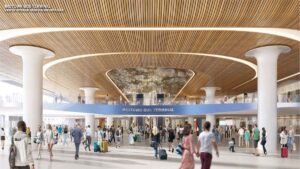
A rendering of one of the entrances to be built as part of Moynihan Station's first phase.

To much fanfare, USDOT announced the winners of the stimulus’ TIGER (Transportation Investment Generating Economic Recovery) grants yesterday, with two coming to our region.

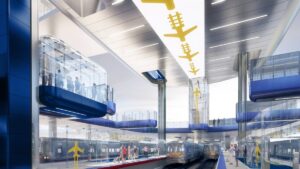
New York City’s Moynihan Station project to convert the Farley Post Office to a train hall received $83 million and now has enough funds for the first phase of construction. This phase will add two new entrances to Penn Station west of Eighth Avenue; add additional escalators, elevators, and stairs to train platforms; and expand the western part of Penn Station, reducing the amount of time it takes passengers to deboard trains and making more frequent service possible. The award was applauded by the Friends of Moynihan Station, an alliance of groups supporting the project that includes TSTC.

Counties in Pennsylvania and southern New Jersey won $23 million for expansion of bike and pedestrian trails that will fill gaps in the Philadelphia region’s trail network and the East Coast Greenway.

Unfortunately, with over $56 billion in applications submitted for the $1.5 billion program, many worthy projects missed out on funds. Among the worthiest was New Haven’s plan to use TIGER funds to jump start a replacement of Route 34 with more walkable urban development. Thankfully, New Haven Mayor John DeStefano has said he will “find the resources” for the project even without the grant.

The TIGER program was designed to fund projects that bolster sustainability, and provided a glimpse into the Obama administration’s green transportation philosophy. Reconnecting America points out that only 23% of program funds went to roads, with the rest split between freight, transit, bike and pedestrian, and multimodal projects.

Image: Via Friends of Moynihan Station.

Bookmark and Share

NYC Public Advocate Planning Actions on Student Passes

De Blasio.

NYC Public Advocate Bill de Blasio is mobilizing parents and straphangers in defense of the city’s endangered free student MetroCards. His office is seeking volunteers to hand out flyers at over 20 subway stations between 7am and 9:30am tomorrow, Thursday, February 18. The flyers will ask recipients to call Gov. Paterson and legislative leaders to restore the free student cards, which the MTA will cut to plug its latest budget gap. The state and city used to fully fund student passes, but their share of the costs has dwindled over the years. According to the Daily News, the state now contributes only $6 million annually towards a program the MTA says costs $214 million (the governor has proposed a slight increase, to $25 million).

Those interested in participating should contact José Davila at jdavila@pubadvocate.nyc.gov or (212) 669-7200. Flyering will take place at the following stations:

Bronx: 3rd Ave-149 St (2, 5); 161 St-Yankee Stadium (B, D, 4); Fordham Rd-Jerome Ave (4); Parkchester (6)

Brooklyn: DeKalb Ave (B, M, Q, R); Nostrand Ave (A, C); 7th Ave (F, G); 36 St (D, M, N, R); 59 St (N, R); Church Ave (F, G); Kings Highway (B, Q); Flatbush Ave-Brooklyn College (2, 5)

Manhattan: Canal St (J, M, N, R, Q, W, Z, 6); 72 St (1, 2, 3); 86 St (4, 5, 6); 168 St (A, C, 1)

Queens: 46 St-Bliss St (7); 74 St-Broadway (7); Jackson Heights-Roosevelt Ave (E, F, R, V, G); Forest Hills-71 Ave (E, F, R, V, G); Jamaica Center – Parsons/Archer (E, J, Z); Flushing-Main St (7)

Staten Island: SI Ferry Terminal (Staten Island side)

Bookmark and Share

The Rising Cost of New Jersey's Toll Road Widenings

During his Thursday budget speech, Gov. Christie took aim at transit riders and said they should prepare for fare hikes and service increases — even though the governor listed NJ Transit as one of several programs that are being slashed even though they “actually have merit, and in most cases make sense.” But there were two clear examples of government waste that the governor didn’t mention:  The widenings of the NJ Turnpike and Garden State Parkway, which are expected to cost the state $3.6 billion.

When these projects were introduced to the public by then-Acting Governor Codey in 2004 and 2005, they carried relatively modest price tags. But more realistic estimates from recent years tell a different story:

Year New Jersey Turnpike (exits 6-8A) Garden State Parkway (30-80) Total
2004/5 $1,300M $135M (exits 63-80 only) $1.4B
2007 $2,000M $500M $2.5B
2008 $2,500M $800M $3.3B
2009 $2,700M $900M $3.6B

These projects would be bad ideas even in flush times. The Turnpike widening will exacerbate traffic and sprawl in surrounding areas, while the Parkway project is designed to fail and will offer virtually no congestion relief even in the short-term.

Christie himself has outlined a possible solution. In his budget speech, the governor said that some state projects should be delayed “until the state has the resources to pay for them.” Given New Jersey’s financial condition and the continued decline of toll road traffic, this would be a fiscally responsible approach to the widening projects. Deferring the projects would also give the governor time to review whether they are really in the state’s best interests.

Bookmark and Share

Christie: An Anti-Transit Governor?

Christie, during his budget speech.

Addressing a joint session of the state legislature yesterday morning, Governor Christie announced that he will cut state funding to NJ Transit by $33 million as part of an effort to close the state’s $2 billion budget deficit. He charged the agency with “patronage hiring” and suggested that it look to service cuts and fare increases to make up the difference. The cut comes on top of a $62 million cut enacted last year, and Christie’s transportation transition team has warned that the agency will face a $200 million budget gap in the next fiscal year.

It’s increasingly looking like we have an anti-transit governor,” Tri-State Transportation Campaign executive director Kate Slevin told the Associated Press in response. Christie ruled out increasing the state gas tax earlier this year.

TSTC and a broad coalition of business, labor, environmental, and planning groups immediately called on Governor Christie to reconsider his proposal, saying that transit fare increases and service cuts would hurt the state’s economy and environment, and that commuters will face drastically higher fares, longer waits at stations, more congestion on roadways, and worsened air pollution.

“Raising fees for transit use, instead of raising fees for road use, will dampen the years of progress that the state has made increasing transit ridership, focusing growth and redevelopment near transit stations and working to get more cars off the road,” said Peter Kasabach, executive director of NJ Future. NJ Transit ridership has increased by almost 50% over the past decade, far outpacing the increase in driving.

State Assembly Transportation Chair John Wisniewski said his committee would review the budget cuts, saying that any resulting fare hikes would represent “increasing taxes on working families.”

Opportunities to Respond

Governor Christie is sending the wrong message for the state’s transportation priorities by penalizing transit riders while refusing to consider an increase in the gas tax or other driver user fees. Luckily, the public has the opportunity to speak out:

  • Wednesday, February 17 – 10am in the State House Annex,  Committee Room 11. The Assembly Budget Committee will be taking testimony on any of the cuts in Governor Christie’s proposal.
  • Wednesday, February 17 – NJ Transit Board meeting at 2pm at NJTransit Headquarters, 1 Penn Plaza East, Newark NJ.
  • Thursday, February 18 – 10am in the State House Annex,  Committee Room 11. The Assembly Transportation Committee will hold a hearing specifically on the transit cuts.

By law, NJ Transit must also hold public hearings before implementing any fare increases or service cuts that result from the slashes to state aid. MTR will publish the dates and time of those hearings after they are announced.

Image: Matt Rainey/Star-Ledger.

Bookmark and Share

Broadway Makeover is a Hit

New Yorkers approve of the new Broadway, and the plazas have improved both safety and travel speeds.

Mayor Bloomberg and NYCDOT Commissioner Janette Sadik-Khan announced this morning that the makeover of Broadway, with pedestrian plazas replacing traffic lanes for seven blocks in Midtown, will become permanent. Backing up the decision is data showing that the change has improved pedestrian and driver safety and sped up car and bus traffic — and that New Yorkers who spend time in the area like the changes.

Injuries for pedestrians and motorists have dropped significantly in Times and Herald Squares. (Data is via NYPD.)

The extensive data that went into the decision is available in a report on NYCDOT’s website. In brief:

  • Safety dramatically improved, with pedestrian injuries declining by 35% and motorist and passenger injuries dropping 63%.
  • Travel speeds improved by 7% in West Midtown. Northbound car speeds jumped by 17%, while southbound speeds fell by 2%. Buses on Sixth Avenue were 13% faster, and 2% slower on Seventh Ave. However, wait time for Seventh Ave. bus passengers was cut in half, since many buses that had previously used Broadway were rerouted to Seventh Ave.
  • Pedestrian traffic increased by 11% in Times Square and 6% in Herald Square.
  • According to surveys done by the Times Square Alliance, majorities of NYC residents, area employees, retailers, and theatergoers said that the pedestrian plazas had improved the neighborhood.

Commissioner Sadik-Khan said that the city would hold a design competition to decide the plazas’ final form.  The plazas would be refurbished in the short term and construction on the permanent design will begin in 2012.  She also said that many city residents had expressed interest in expanding the plazas south. For his part, Mayor Bloomberg said that streets needed to be designed for all users.

In a statement, the Campaign said that “Mayor Bloomberg and NYCDOT Commissioner Janette Sadik-Khan’s bold experiment has been an unqualified success,” and suggested that the mayor “consider a similar approach on streets like 32nd Street near Penn Station, where pedestrians are routinely forced into the roadway.”

Images: Top – Clarence Eckerson via Streetsblog. Table – from NYCDOT “Green Light for Midtown” report, comparing June-November NYPD data from 2006-08 (before car-free Broadway plan) to 2009 (after).

Bookmark and Share