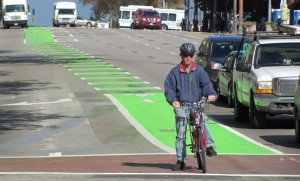
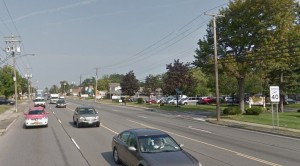
 Multiple lanes of fast-moving cars, destinations that draw foot traffic from surrounding areas, and scarce crosswalks or other pedestrian accommodations: The ingredients which make a deadly road for walkers are all present on Long Island's Hempstead Turnpike.
For the third year in a row, Hempstead Turnpike in Nassau County is the region’s most dangerous road for walking, according to Tri-State Transportation Campaign’s just-released Most Dangerous Roads for Walking report. Between 2007 and 2009, twelve pedestrians were killed on that 16-mile stretch of suburban highway cutting through Nassau County’s most densely populated towns. The victims included three seniors, and a pair of adult brothers.
At four to six lanes across along most of its length, and lined with strip malls, fast food restaurants, and shopping centers, the Hempstead Turnpike serves as a perfect example of a wide suburban “arterial” road. In the tri-state region, nearly two-thirds (63%) of pedestrian fatalities occur on these types of roads.
Manhattan’s Broadway ranked second in the Campaign’s report, with 11 fatalities over the three-year period. With the exception of one fatality near City Hall, all of the Broadway pedestrian deaths occurred in northern Manhattan, where the road handles two-way traffic. There were no fatalities along the stretches of Broadway that have been transformed through NYC Department of Transportation’s Green Light for Midtown program.
 TSTC's Most Dangerous Roads for Walking report includes a ranking of roads in the region by number of pedestrian fatalities, fact sheets and Google Maps which break out the analysis by county, and recommendations for how to make roads safer. Click to read.
The Campaign’s analysis found that the Burlington Pike (US-130) in Burlington County was the most dangerous road in New Jersey. Over three years, ten pedestrians were killed on the road. Like the Hempstead Turnpike, Burlington Pike is four to six lanes across most of the route’s 23 miles, with shops and retail destinations along both sides of the road, but few crosswalks.
The Campaign’s findings confirm previous reports which concluded that road design — and in particular, the design of conventional arterials — is a primary contributor to pedestrian risk. With multiple lanes, long sightlines, and fewer interruptions from cross traffic or pedestrians, arterials encourage traffic to speed. Prevailing travel speeds on arterials tend to be upwards of 40 mph. A pedestrian struck by a vehicle traveling at this speeds has a dismal 15 percent chance of survival.
Communities across the tri-state region are beginning to recognize the hazards of typical suburban-style road design. Connecticut has implemented a “Complete Streets” law requiring that new construction seek to accommodate the needs of all roads users. And late last year, outgoing governor Jodi Rell announced significant changes to ConnDOT’s bicycle and pedestrian policies aimed at improving the delivery and increasing the funding available for bicycle and pedestrian projects. New Jersey’s Department of Transportation has increased funding for bicycle and pedestrian projects and recently signed a Complete Streets policy. New York State has implemented a SafeSeniors program seeking to address pedestrian safety for older New Yorkers, and NYCDOT has emerged as a national leader in carving out safe public spaces for pedestrians and bicyclists. Elsewhere in downstate New York, at least six communities have adopted Complete Streets policies or resolutions.
But with approximately 415 pedestrian killed on the region’s roadways every year, there’s still a long way to go. A good place to start would be for the New York State legislature to pass the critically-needed Complete Streets bill that has languished in Albany for nearly a year. Beyond that, the Campaign recommends that all three states in the region:
- Make pedestrian safety a policy and investment priority;
- Protect the most vulnerable pedestrians through increased spending on Safe Routes to School, Safe Routes to Transit, and Safe Routes for Seniors programs;
- Designate a fair share of federal funding to improving bicycling and walking; and,
- Ask our congressional delegation to fight to protect and expand federal programs that provide significant funding for bicycle and pedestrian projects.
After the jump, the full ranking of the region’s most dangerous roads.
» Continue reading…
Click to read state budget documents.
Transportation shares in the sacrifice demanded by Gov. Cuomo’s executive budget, released yesterday in the first step of what is sure to be a long and contentious journey as the governor and State Legislature work out the budget. But it doesn’t seem as though the proposed cuts [...]
In November, Lt. Gov. Richard Ravitch issued an eye-opening review of the state’s huge transportation funding challenge. As a call to action, Ravitch repeatedly cited the need to fix aging bridges like the Kosciusko and Tappan Zee. His report described the Tappan Zee as costing “between $6 and $10 billion.” But the bridge is [...]
This morning, Gov. Cuomo announced he would nominate Joan McDonald to run NYSDOT. McDonald is currently Commissioner of CT’s Dept. of Economic and Community Development. She has previous transportation experience at the NYC Economic Development Corporation, NYCDOT, and Metro-North.
McDonald.
In response, TSTC released the following statement:
The Tri-State Transportation Campaign welcomes the [...]
 Governor Andrew Cuomo and state legislators will face immediate transportation challenges in 2011.
New York transportation agencies might have hoped for a reprieve from the tough budgetary environment of 2009. 2010 was hardly a respite, however, as governments throughout the region continued to be squeezed by the economic downturn. The overall story of 2010 was one of fare hikes, service cuts, and diminished expectations. But advocates were able to win several policy reforms, and leaders like NYCDOT Commissioner Janette Sadik-Khan and MTA Chairman Jay Walder had success in adapting to hard times. Here are some of the themes from the year:
State and Local Policy Reform
During the first half of the year, advocates repeatedly trekked to Albany to press for policy reform. By the close of session, the Legislature had passed a statewide smart growth bill, given NYC the ability to use bus lane enforcement cameras, and made life a little safer for pedestrians through the passage of Hayley and Diego’s Law (which created penalties for careless driving) and Elle’s Law (which strengthened penalties for reckless drivers that injure or kill a pedestrian). One major priority that wasn’t reached this year was a state complete streets bill, but advocates succeeded in pushing it up the agenda; the bill has some level of support from incoming governor Andrew Cuomo.
And while proponents of complete streets came up just short at the state level in 2010, they poured just as much energy into local reform. Partnering with smart local leaders, advocates used data in Babylon, Islip, and Brookhaven; a health-focused approach in Kingston; and a locally oriented strategy in Elizabethtown to win passage of complete streets policies in all five municipalities.
Infrastructure Needs Not Met
Funding is an issue at all of the state’s major transportation agencies. Coming into 2010, NYSDOT had already drafted a five-year capital spending program that was clearly fiscally constrained. But under orders from Gov. Paterson, the agency released an even smaller capital program which will not hold the line on bridge repair and cuts smart growth programs. The MTA goes into 2011 without funding for capital projects in 2012 and beyond. In November, Lt. Gov. Richard Ravitch released a report which found that the state would need to come up with another $1.3 billion a year in dedicated revenue to support the MTA and NYSDOT capital plans. At the end of the year, the Port Authority released an underwhelming budget that largely maintains the status quo.
Jay Walder Takes Charge at the MTA
In January, new MTA Chairman Jay Walder released a strategic plan based on his first 100 days on the job. Its title fit right with the spirit of the times: “Making Every Dollar Count.” The agency subsequently used administrative streamlinings resulting in hundreds of millions of dollars in savings.
But a transportation funding plan put together by elected officials in 2009, which had been seen as barely sufficient, proved to be even less sufficient than that, as dedicated transit taxes continued to bring in less revenue than predicted. Politicians swept $160 million from the supposedly dedicated taxes into the state budget. The result was a gaping budget hole. The MTA eventually relented in an attempt to cut or have NYC and the state pick up more of the cost of providing free NYC student MetroCards. But the worst service cuts in decades, along with a 7.5% fare increase that went into effect at the end of the year, will hardly endear the agency to its riders.
Transit riders have benefited from the new common-sense approach Walder has brought to technology projects, however. For example, the MTA has rolled out subway countdown clocks that use existing technology, instead of waiting for more expensive solutions managers wanted before Walder’s arrival. The MTA also released transit data to developers, allowing third parties to develop smartphone apps and websites at essentially no cost, and promised drivers faster commutes with nonstop tolls at the Henry Hudson Bridge. » Continue reading…
Earlier this week, TSTC sent a letter to Governor-Elect Cuomo outlining transportation priorities for 2011 and beyond. Many items fit directly into his campaign promises of encouraging smart growth, reforming government, expanding transit, and encouraging biking and walking.
With the state funding crisis in mind, the letter is focused on maintaining transit funding and [...]
By chance, MTR passed through Main Street in Smithtown last week and was greeted with a welcome surprise — safety improvements being undertaken as part of NYSDOT’s Safe Seniors pilot program are underway.
New pedestrian amenities being installed on Main Street in Smithtown.
A fence, both decorative and utilitarian, has been installed to prevent [...]
Transportation Enhancements money was used for part of NYC's Ninth Avenue complete streets redesign.
Local governments in New York are still waiting for the state to distribute tens of millions of dollars from the federal Transportation Enhancements (TE) program, which is primarily used for bicycle and pedestrian projects. The last round of grants [...]
The area targeted for development in New Haven.
Two highway removal projects in the region got a boost of federal funds today. USDOT announced that New Haven’s Route 34 and the South Bronx’s Sheridan Expressway will receive $16 million and $1.5 million respectively to advance plans to convert these underutilized highway corridors into [...]
Bus in SIE HOV2+/bus lane
During a recent public information session, NYS Department of Transportation unveiled its analysis showing that carpools with at least 2 passengers (HOV2+) add to bus lane delays and congestion in the Staten Island Expressway bus lanes. The department’s questionable decision to open up the bus lanes to cars [...]
|
Masthead Mobilizing the Region is published by the staff of the Tri-State Transportation Campaign.
Editors
|