
LI Bus riders have long been caught in the middle of an annual game of chicken between the MTA and Nassau County over who should fund one of the nation’s largest suburban bus systems. This year it is particularly dire. The MTA says it will cut all of its funding to LI Bus. County Executive Ed Mangano’s response was to call for MTA Chairman Jay Walder’s resignation.
Mangano’s comments came as pressure was building on him to work for a solution. At a rally two weeks ago, Tri-State Transportation Campaign, Transport Workers Union, the LI Federation of Labor and New York Communities for Change called on the MTA and Nassau County to work together to fund LI Bus. But working together seems to be the last thing on their minds.
The MTA’s proposal to withdraw its entire funding contribution is misguided and should be withdrawn immediately. This move would devastate the system, leaving one of the largest suburban bus systems in the country a shell of its former self. It is particularly premature considering that a solution to funding LI Bus is currently being studied. In the 2010-2014 Capital Program, the MTA has allocated funding to study regional bus, a solution that may put LI Bus on firm financial footing for the long-term.
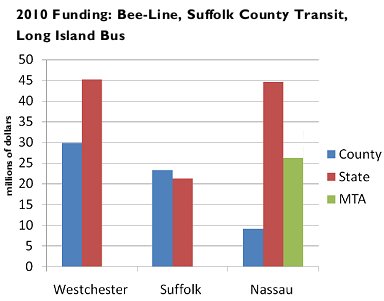
But the MTA’s proposal is only half the story. Over the past decade, Nassau County has shirked its responsibility to fund the system and currently contributes only $9.1 million a year while the MTA and New York State have picked up the slack. Nassau is the only county in the NYC suburbs to get such a generous arrangement (see chart at right).
A logical compromise would be for Nassau County to increase its contribution over time in return for continued MTA support. Instead, the county has offered red herrings like calling for a privatized bus system, suing the MTA over the payroll tax, and the call for Walder’s head. The Newsday editorial board called this a “cheap shot” and an attempt to “distract attention from the challenges of coming up with a 2011 budget,” which would ostensibly be where the County would propose how it would fund LI Bus with or without the MTA’s subsidy.
With a structural deficit of $286 million, Nassau County has claimed poverty, perhaps rightfully so. But if Suffolk and Westchester Counties can find a way to fund buses in these tough economic times, so can Nassau. It’s not as if Nassau County isn’t willing to spend money on transportation. Even with its deficit, the County recently decided to appropriate $3 million to widen and repair Jackson Avenue in Syosset.
With the deadline for the 2011 budget next Wednesday, September 15, the question for County Executive Mangano and the Nassau County Legislature is: Are they willing to find money for LI Bus riders? MTA Chairman Walder and the rest of the MTA board face their own question: Will they step back from a hard-line position that will mean great suffering for transit users?
Without a solution, Long Island Bus riders — who can testify at an MTA public hearing on Sept. 16 in Garden City — will be asking themselves a different question: How will we get to work next year?
Image: Graphic using data from Bee-Line, Suffolk County Transit, and MTA. (The data provided to TSTC by the agencies is projected through the end of the year and is therefore preliminary.)
The MTA has no choice but to do this. It is taking money from other regions to service Nassau County’s buses. That is depriving other regions of the ability to sustain their services. It has to end. The MTA cannot afford to cry poverty and then pay for things it cannot afford.
Obviously, an easier way to solve this problem (and the MTA proposed it in 2009) is to double the Long Island Bus fare. Although more expensive that now, it is less expensive than a cab.
[…] MTA has proposed cutting all its funding for LI Bus. In an e-mail to transit supporters, Troiano lamented the […]
[…] the MTA over the payroll tax and calling for MTA Chairman Jay Walder’s resignation, have only poisoned the well and potentially put LI Bus riders in greater danger of losing a transit lifeline. The failure of […]
[…] The microcosm of Nassau County By Benjamin Kabak Nassau County has not invested in its own subway system. (Graph via TSTC) […]
[…] the face of historic underfunding by Nassau County and a hastily proposed $26 million cut from the MTA, the LI Bus system is at a […]
[…] Three private companies bid for LI Bus as future hazy By Benjamin Kabak Nassau County has not invested in its own bus system. (Graph via TSTC) […]
[…] development is a tremendous step forward after a contentious six months of negotiations between the MTA and Nassau County. But this progress must not stop […]
[…] Nassau County pays less for its bus system than Westchester or Suffolk County, and is the only one to receive MTA subsidy. Image: Tri-State Transportation Campaign. […]
[…] MTA planning steep cuts to Long Island Bus By Benjamin Kabak Nassau County has not invested in its own bus system. (Graph via TSTC) […]
[…] has refused to increase Nassau County’s contribution to LI Bus even though it is the only suburban county to receive MTA funding for its bus system, and its contribution to the system is at historic lows. […]
[…] decade, the MTA has provided more of the bus system’s funding than the county has, though no other suburban county receives such a deal. The agency now plans to cut this contribution. But rather than sit down with […]
[…] For Long Island Bus, a temporary reprieve By Benjamin Kabak Nassau County has not invested in its own bus system. (Graph via TSTC) […]
[…] MTA Board votes to terminate LI Bus contract By Benjamin Kabak Nassau County has not invested in its own bus system. (Graph via TSTC) […]
[…] on the amount of money Westchester and Suffolk County contribute to their privately operated bus systems, this may be an unrealistic ask. (Westchester pays $30 […]
[…] Wink’s proposal is still a rough sketch, but is more realistic than any policy prescription offered by the County to address the funding shortfall at LI Bus. Last week, County officials offered more details on […]